
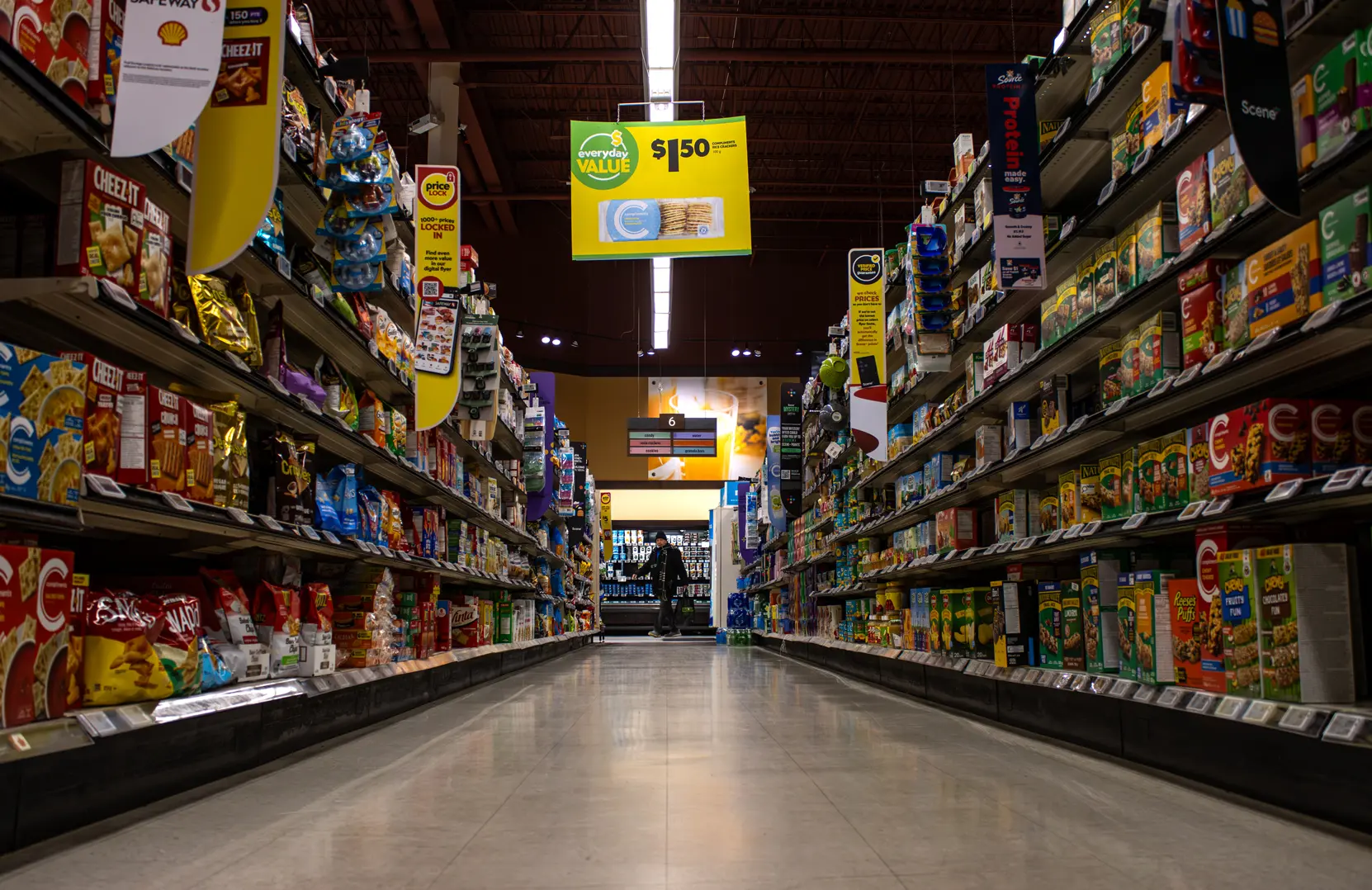
An aisle in Safeway promoting sales on snacks and chips. Amanda Erickson/The Griff
Find me one person who is happy with how much they pay for essential food. Seriously, unless you’re swimming in cash, budgeting for groceries feels like budgeting for an investment, not a necessity. Food products are the thing we NEED, like, PHYSICALLY need to live, and we’re potentially paying upwards of $1,000 a month on them. That’s insane. In case you haven’t heard, grocery prices in Canada are very high. This is not news to anyone who has bought something from a store in the last few years. Food here is crazy expensive. It’s complete bullshit that people might blow half of their paycheck on bananas and bread.
The University of Calgary conducted a study on the recent grocery price increase in Canada and Alberta. I’ll just give you their numbers, because they speak for themselves.
- The average monthly cost for groceries in 2019 was $974, and increased to $1,227 in 2024
- As of 2024, food prices have increased 10.4 per cent year-over-year
- In 2022, Alberta led the country in the food insecurity crisis, with 22 per cent of families reporting food insecurity in the last 12 months.
With these insane stats, we have to ask ourselves what is wrong with our current system. While there are many factors at play, the most significant issue is the lack of competition in Canada’s grocery store market. Canada could be the poster child for supermarket monopolies. Almost all of the supermarkets you shop at in this country are owned by three companies, the three horsemen, screwing you over. The largest of these is Loblaws, which owns Superstore, NoFrills, Shoppers Drug Mart, T&T, and more. The other two conglomerates are Sobeys and Metro, which own many of the smaller chain grocery stores, the most notable being Sobeys’ ownership of Safeway. There are way more stores owned by these three I didn’t mention, so if you even care a little bit, it’s worth looking up.
What is a Canadian supposed to do, buy food from Dollarama? Live off of ramen (which isn’t even that cheap anymore)? Or just eat sleep for dinner.
Fortunately, Prime Minister Carney has a plan, but is it even any good? Probably not, because it’s the government. But for the sake of argument, let’s see if our fiscally responsible former banker of a prime minister can think up a way to help out people experiencing poverty, or just everybody at this point, with where we’re at nowadays — except like three white dudes.
Mark Carney’s new plan aims to counter the struggles Canadians face with food prices. However, I’m not so sure it’s a real fix for this issue. Like a band-aid for an infection, the problem runs deep through the systems that allow Canadian companies to make money. Carney is insistent that “the biggest long-term payoffs of this transformation will take time to be felt.” Carney’s primary long-term goals are to “strengthen domestic food production” by supporting producers, and strengthening supply chains, overall supporting Canada’s economy through the food industry. What I think will have a larger effect than is being discussed in Carney’s press release is implementing unit price labelling as well as supporting the Competition Bureau to incentivize more competition in the food industry.
While these are good changes for the long term, whether or not they actually achieve this goal is yet to be seen, so I guess we’ll have to wait. However, in the short term, the government just plans to give people some money each year for the next four years. Titled the “Canada Groceries and Essentials Benefit” — formerly the Goods and Services Tax (GST) Credit, the goal of this initiative is to give Canadians a tax credit on groceries. Depending on the size of the household, they would get different amounts: a “family of four will receive up to $1,890 this year, and about $1,400 a year for the next four years; and a single person will receive up to $950 this year, and about $700 a year for the next four years.” Which, based on the information provided by the University of Calgary, is the equivalent of like one month of groceries each year. That isn’t nothing, but it certainly is not enough to make a massive impact.
My opinion — as someone who is by no means an expert in finance — is that increasing competition in the Canadian food market will significantly reduce food costs. When most Canadians buy almost all of their food from only three stores, those stores can set prices as high as they want because Canadians don’t have much choice except to buy from them. Hopefully, this new initiative will help ease some of the struggles Canadians are facing right now, but only time will tell.





Good article. Manitoba premier Ab Kinew plans to make his province no longer ruled by grocery conglomerates. How can we make this a reality across Canada?
how did safeway stop any other grocery store from opening?
AI Overview
Safeway (now owned by Sobeys/Empire Company Ltd.) historically stopped other grocery stores from opening primarily by utilizing restrictive covenants—legal agreements attached to property deeds and leases that prohibit the sale or lease of the location to competing food retailers.
These tactics were most commonly used in Western Canada, particularly in older neighborhoods, to maintain market dominance even after closing a specific store location.
Key Methods Used to Prevent Competition:
Restrictive Covenants and Deeds: When closing a store, Safeway would often sell the land while including a legal restriction in the deed, preventing any future owner or tenant from operating a grocery store, bakery, or butcher shop on the site.
Perpetual Controls: Some of these restrictions were in place for decades, essentially forcing potential competitors to look elsewhere and creating “food deserts”—areas in cities (such as in Edmonton) with limited access to fresh, affordable food.
Exclusivity Clauses in Leases: When renting space, Safeway (and other large chains) would include clauses in their leases that prevent the landlord from leasing other units in the same plaza or nearby area to competitor grocers.
Acquisitions and Site Control: In some cases, Safeway would acquire properties or enter into agreements to secure key retail spots, preventing new, independent grocers from setting up in mature, high-traffic neighborhoods.
Competition Bureau
Impact and Current Scrutiny
Food Deserts: These restrictions led to vacant former Safeway stores that could not be repurposed for other food sellers, restricting competition and limiting choices for residents.
Investigation by Competition Bureau: The Canadian Competition Bureau has investigated these practices, finding they harm competition by raising prices and reducing access to food.
Voluntary Removal: Following increased scrutiny, Sobeys (the current owner) has voluntarily removed some of these covenants, such as in Crowsnest Pass, Alberta, to allow new retailers to enter the market.
Competition Bureau
Note: Sobeys, which bought Safeway Canada in 2013, has continued to face investigation over these property controls.
Would you like to know more about the recent actions by the Competition Bureau regarding these covenants?
Perhaps someone on your staff could investigate why corporations have so much power?