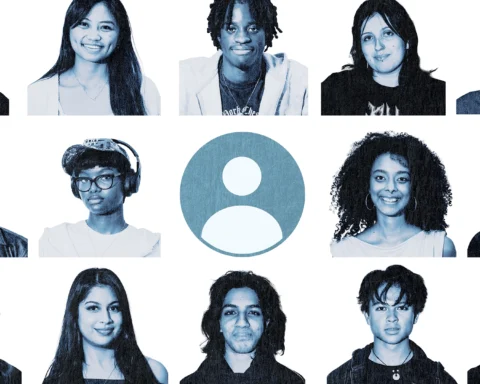
What makes an Albertan? Is it someone who pays tax dollars and funds schools? Someone whose home is on prairie land?
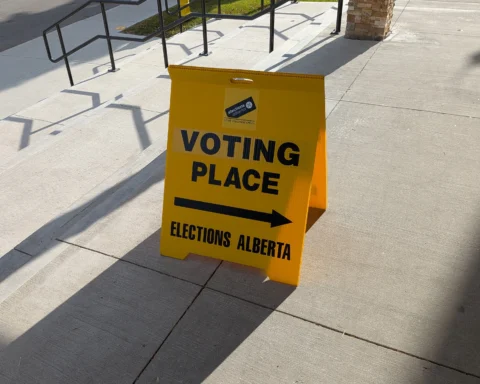
Question one of the 2026 Alberta referendum questioned that. It asked if the Alberta government should reduce immigration to prioritize “giving Albertans” employment opportunities.
This questioning of what makes an “Albertan” is just one piece of othering language in the referendum.
Othering language is a form of media framing that serves to “other” individuals from the majority.
This framing involves focusing on differences within a group (e.g., being an immigrant) and overemphasizing them to undermine the group’s sense of connection with others.
Question 4 asked if immigrants should be charged an additional fee for Canada’s healthcare (I thought Canadian healthcare was universal?) and education.
These questions, along with the other three immigration-related questions, absolved the government of blame for the scarcity problems in provincial social services.
It’s scapegoating.
Asking a population whether others within that same population should receive the same social support and rights as the others is extremely anti-democratic. As of the 2021 census, immigrants make up 23.2 per cent of Alberta’s population — the idea that almost a quarter of our people are undeserving of our democracy is absurd.
The definition of democracy is that it is governed by the people. It’s not governed by those who were lucky enough to have been born here.
Wording and framing
Referendums are not inherently bad, and neither is asking citizens to vote on immigration policy.
The act of a government consulting the people for their opinions is democratic. It’s a genuine display of extracting the will of the people to be the basis of government.
The Canadian Encyclopedia notes this democratic purpose, stating that a referendum is a useful tool for answering a specific question. Specific being the load-bearing word.
The problem with the Alberta referendum was the wording.
A study by Amnesty International found one dominant narrative on Canadian social media: that “mass immigration” posed an existential threat to Canada’s white “legacy” population.
The framing of immigrants in the referendum perpetuated that narrative.
The Alberta government and the perspectives of the white “legacy” Albertans got to define the problems with healthcare, education, and employment, while the others — the marginalized immigrants and non-permanent residents in the province — were left out.
It placed the onus on immigrants rather than, say, government spending.
This frame acts as a method of priming. When the media focuses on certain issues while ignoring others, it “primes” the public to base their decisions on those issues.
The public has now been primed to view immigrants as the problem. They will be more susceptible to othering policies targeting immigrants and non-permanent residents if such policies arise in the future.
This is the psychology behind advertising. Why does Coca-Cola still spend four billion dollars annually on advertising when everyone knows what Coca-Cola is? Because when you see or read something over and over again, you tend to view that piece of information as fact.
You start to believe that Coke really is the best drink to quench your thirst. You start to believe immigrants in Alberta are why our hospitals are overfilled and why our teenagers can’t find jobs.
Why this matters
My mother tried to reassure me the morning after the referendum, after all five immigration questions had a majority vote of ‘yes.’ She said something along the lines of, “nothing is going to happen overnight.”
The Alberta referendum was non-binding, meaning the intent of the votes was to gather public opinion on policy or law. The referendum being non-binding is a common argument I’ve heard for why the wording and results didn’t matter.
But it does.
In healthy democracies, opposing sides are merely political opponents to negotiate with and to compete with in elections.
In deeply polarized democracies, the “other side” is seen as an enemy. Polarized people have a limited worldview and cannot see humanity on the other side.
This makes the public sphere, where the population can discuss politics, express empathetic opinions, and think critically about government policies and performance, die.
Journalism’s role and solutions
The value of information and perspective in democracy is immeasurable. Although journalists can’t babysit the people and convince them to inform themselves, they can surely try.
News releases leading up to the referendum attempted to explain the complex referendum questions.
The journalists were fulfilling a degree of democratic responsibility by informing the public of the referendum. They analyzed what the questions were really asking, and what each vote would mean for the province.
The role of journalists goes beyond information. It is to represent the underrepresented and present differing opinions that provide context and experience.
I spoke with someone the week before referendum day regarding Question 4. They said they were going to vote yes. I knew this person shared my values — they just didn’t understand what that vote would mean.
I explained that immigrants who work, pay taxes, and have Canadian children may be subject to the proposed policy. They paused and went, “Oh.”
Social empathy is the key to understanding, and once you think laterally and empathetically about others, you can see what othering is trying to hide.