
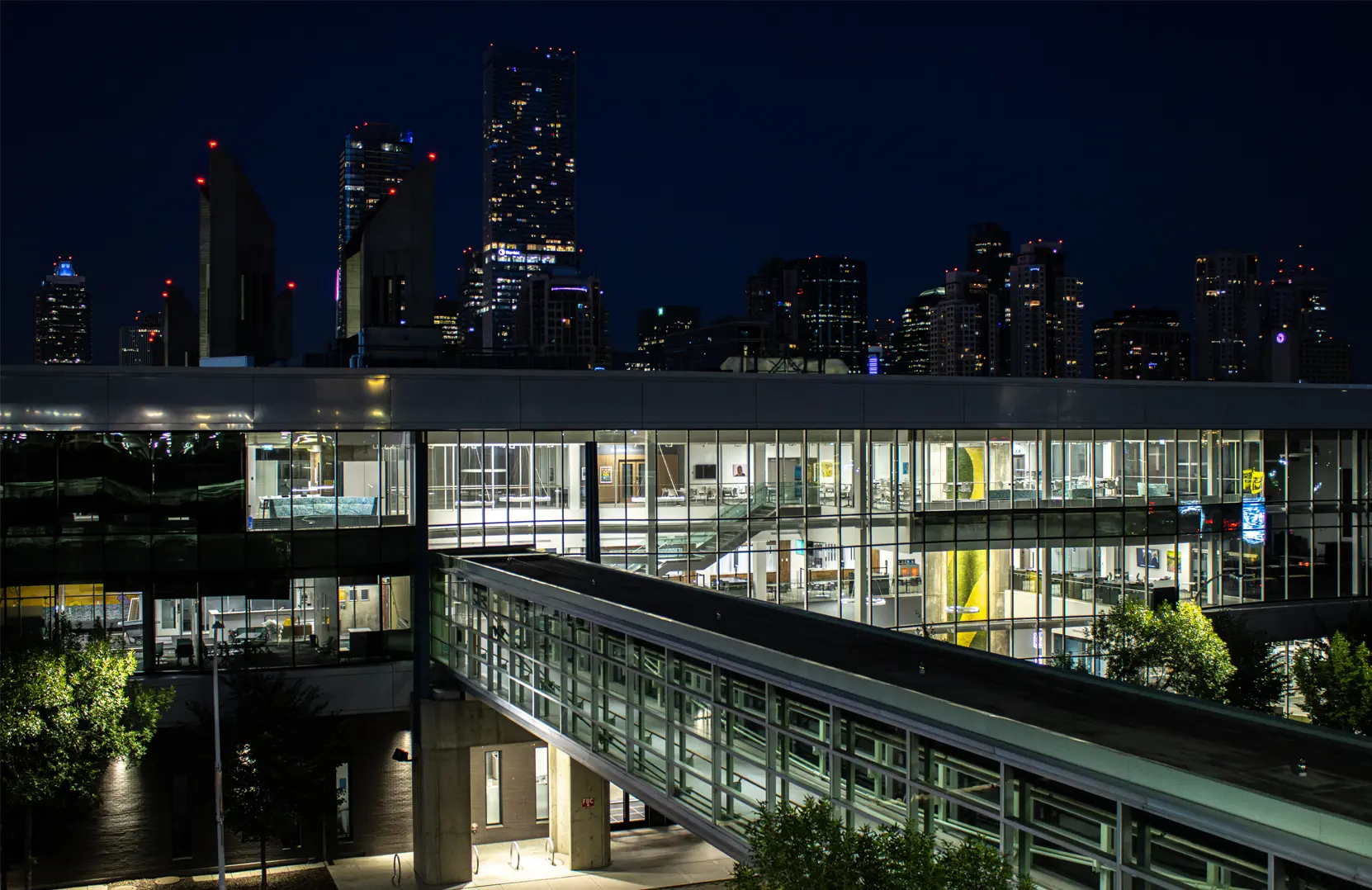
MacEwan’s SAMU building after hours. Amanda Erickson/The Griff
The Indigegogy minor at MacEwan is a first-of-its-kind program. Jaycee Meneen talks about its origins and future.
At the beginning of October, MacEwan University officially unveiled its Indigegogy minor, a portmanteau of “Indigenous pedagogy” coined by Opaskwayak Cree Elder and retired professor Stan Wilson.
Referred to as the first of its kind in Canada, the Indigegogy minor offers MacEwan students a “unique, multi-disciplinary program that puts Indigenous knowledge, experience and cultural perspectives at the heart of the program,” according to the program description. The minor is a multidisciplinary program that incorporates First Nations, Metis and Inuit viewpoints into course materials.
Jaycee Meneen, the Indigenous initiatives lead at MacEwan, says the Indigegogy minor was in development for about three years. Terry Cardinal, associate vice-president (Indigenous initiatives), and Etienna Moostoos-Lafferty, an assistant professor in MacEwan’s department of human services and early learning, worked on the background research to support the logistics of the Indigegogy minor, including planning the courses in the minor and selecting the appropriate instructors.
However the concept of the minor originated years earlier, around 2016 or 2017, during a MacEwan land-based learning camp when Meneen herself was a student at MacEwan. Meneen recalls that at the time, Cardinal facilitated the camp and had discussed the potential of turning it into a full-fledged major or minor program. She reasoned that the camp was healing for Indigenous students and even helped some to not only reconnect with their land, but also reconnect with their cultures—Meneen included.
“It was huge—which is so wild to say that my first introduction to my culture was actually through MacEwan,” Meneen says. “[It] was through MacEwan University, through Terry [Cardinal], through this land-based learning camp class that MacEwan ran for the first time.”
The teachings from the camp helped Meneen build skills and practices that she brought back to her community. Meneen says the land-based learning camp was like a test run, and the interest that grew over time eventually turned into the Indigegogy minor.
“It’s a nice way to essentially put yourself, or at least starting the groundwork of at least pushing through these colonial barriers that every institution runs under, so it’s always about the little steps.”
— Jaycee Meneen, Indigenous Initiatives Lead at MacEwan
The Indigegogy minor is about teaching equality. For example, the minor bridges the relationship between professors and students. Rather than a one-sided approach, where knowledge is passed down from a professor, the minor emphasizes a two-way learning process, says Meneen. The reason for this approach is that Indigenous peoples come from different communities with different cultures and teachings, “so bringing those all together as a group and learning together is something that’s really important, and that’s going to happen in land-based learning,” Meneen adds.
Post-secondary institutions across the country have grappled with reconciliation, marked by the Truth and Reconciliation Commission’s (TRC) 94 Calls to Action in 2015. University leadership across Canada announced plans to “Indigenize” their campuses by expanding Indigenous presence on campuses. It is perhaps more difficult considering the historical roles these institutions played in perpetuating colonial violence against Indigenous peoples. While some scholars have argued that universities perpetuate settler colonialism under the guise of furthering Indigeneity.
The University of Toronto, established in 1827, commissioned a report in 2017 in response to the TRC’s Calls to Action. The report generated 34 recommendations for the University, including the creation of Indigenous spaces on campus and the integration of Indigenous knowledge into curricula.
MacEwan, although a relatively young university, has also made attempts to address the TRC’s Calls to Action, such as establishing an additional Indigenous faculty, increasing Indigenous course content, and finally, the Indigegogy minor. Indigenous students are increasingly enrolling in programs at MacEwan. More than 7.6 per cent of students on campus are Indigenous, putting MacEwan high on the list of universities across the country that have Indigenous students.
Meneen echoes a similar sentiment, emphasizing resilience and resistance. At MacEwan, Meneen says, Indigenous peoples are able to be in a place where they can talk about their cultures, especially considering Canada’s history of assimilation and colonization.
“It’s a nice way to essentially put yourself, or at least starting the groundwork of at least pushing through these colonial barriers that every institution runs under, so it’s always about the little steps,” Meneen says.
“So it’s almost like it’s taking it up a couple of levels. When we have this, level one talk of ‘what are Indigenous peoples?’ We’ve already moved beyond that.”
— Jaycee Meneen, Indigenous Initiatives Lead at MacEwan
She believes that in the long run, Indigenous education in post-secondary institutions will look different—and that’s a good thing. Meneen, along with her colleagues, want to create a piece within the giant institution and grow.
Meneen says the minor is different because it doesn’t observe Indigenous peoples through a Western historical lens. “This is coming from the people themselves,” says Meneen. “So this is coming from our ideas of education and our own ideas about the world and how we see it as Indigenous people.”
“So it’s almost like it’s taking it up a couple of levels. When we have this, level one talk of ‘what are Indigenous peoples?’ We’ve already moved beyond that.”
Instead, students in the minor will undergo teachings and become familiar with knowledge through Elders and Knowledge Keepers. Professors will bring in Elders and Knowledge Keepers, some of whom are survivors of residential schools and the 60’s Scoop.
Meneen says the Indigegogy minor doesn’t observe Indigenous cultures, but instead participates. She puts it another way: with the Western lens, the approach to observing or researching Indigenous peoples may make them feel like they’re ants, but with the approach to the Indigegogy minor, “you are the ant, and you know what, you’re looking at each other.”
“You’re not coming from a top-down; you’re coming from the same playing field.”
Meneen says the Indigegogy minor is a healing journey. She draws on her own experiences as a MacEwan alumna, having majored in political science with a minor in sociology, but doesn’t think it was a healing experience. With the Indigegogy minor, Meneen says it can not only help students heal from trauma but also provide them with the knowledge to bring back to their communities.
“But Indigegogy is different in that way, where it actually—it truly—the development really came from love, and came from love for students and love for Indigenous students, and wanting to show them that you can do this and you can heal, you can get it in a colonial institution, and you can come out unscathed, you’ve come out loved, and you can come out well connected.”
Files from Amanda Lou.
very nice article! Treaty 6 in the house.