
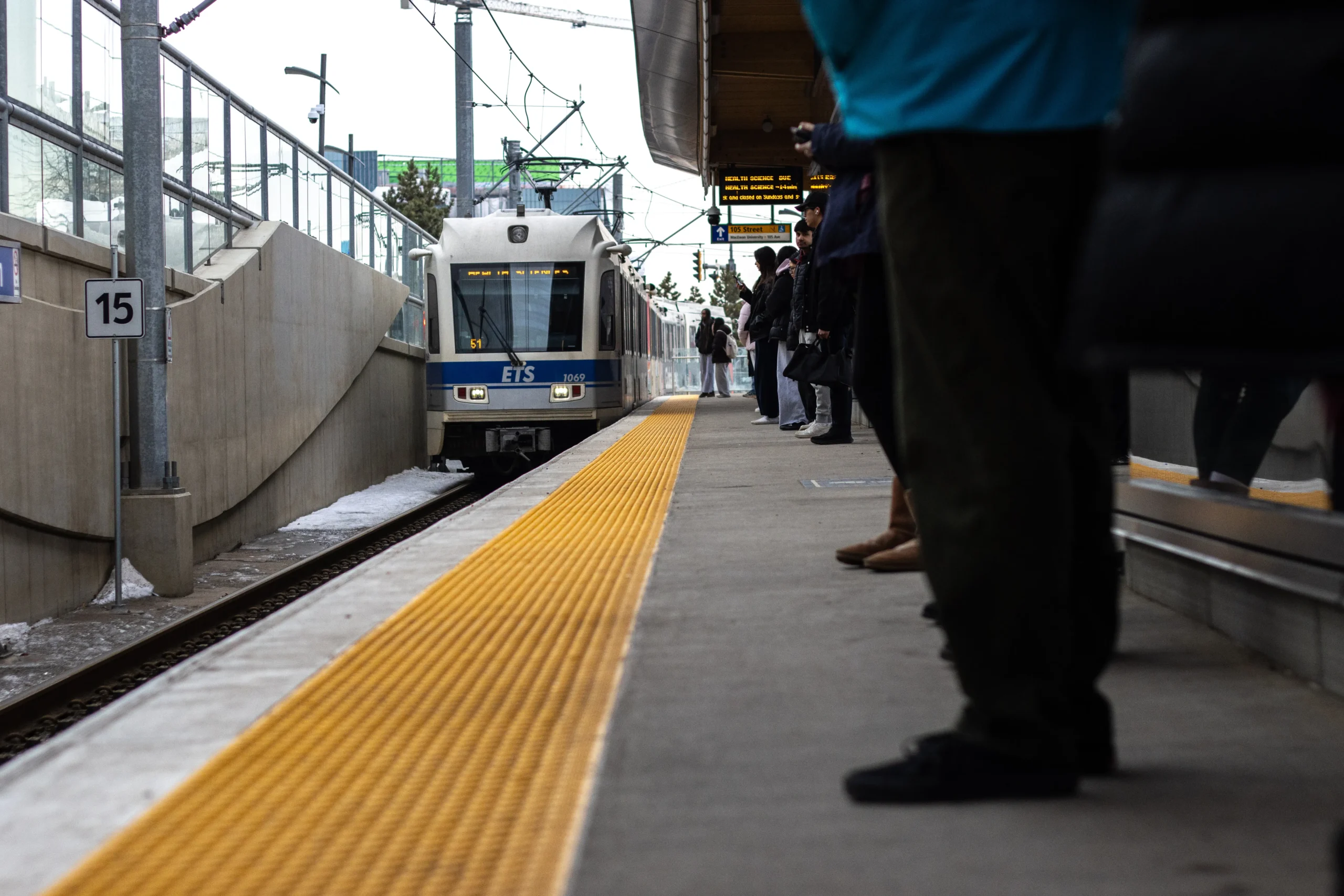
The MacEwan LRT station. Amanda Erickson/The Griff.
From my home near Londonderry Mall, I spend an average of two hours each day on the bus to and from MacEwan, allowing me unfettered access to the cultural rot and urban decay blighting the so-called “City of Champions.” When I learned Edmonton was rolling out more peace officers to patrol transit hubs and ride transit lines, my initial reaction was one of support. 15 peace officers, now with an additional 15 added by the end of summer, bringing the total to 126 officers, seems an effective way to combat the meteoric rise in transit crime. More policing is more better, right?
The more I thought about the problem, running the numbers through my head, the less it added up to a solution. ETS operates 995 buses across more than 180 routes going to 24 transit centres, while the LRT has over 120 cars servicing 29 stops and stations. Combined with scaling officer presence from two to four-person teams, you begin to see the deficit. If all 126 dedicated officers worked seven days a week, that would only cover 32 of the 55 transit hubs, omitting the stated initiative to have officers conduct fare checks. The generous might call the intention a good start.
I will concede the unreasonableness of expecting four peace officers to be standing around at every transit station, but the public perceptions of safety when using Edmonton transit are not favourable with only 62 per cent of people feeling safe on transit. A recent CBC National News investigation found that between 2015 and 2024, physical assaults on Edmonton public transit surged by 260 per cent. We are witnessing the symptomology of systemic issues that more law enforcement alone cannot alleviate. The same CBC investigation found 22 per cent of people arrested on public transit were responsible for nearly half of all crimes committed on transit. A small cohort of individuals, well known to police with extensive criminal histories, is making transit spaces unsafe for commuters.
The City of Edmonton is proffering simple solutions to complex problems. 30 more peace officers patrolling Edmonton transit may arguably be useful, but they are only a small piece of the puzzle affecting Canadian cities. A good place to begin would be where the CBC investigation details federal bail reform for violent and repeat offenders. Our soft approach of catch-and-release policing enables the cycle of violence to continue in perpetuity. I know criminal justice is a touchy subject, but I propose several accompanying improvements to supplement the overhauling of our bond system.
Foundationally, we should look to Nordic models of prison systems, focusing on creating environments of stability as opposed to primarily punitive measures. In my mind, it makes more sense to build a prison where the incarcerated never want to leave, versus an environment that offenders will desperately avoid returning to. People forget that forfeiture of freedom and segregation from society are the punishment. Who cares if they have access to certain comforts and luxuries? The second reform I propose is the return of publicly funded psychiatric hospitals. I understand these institutions have a draconian reputation, but the reality is that not every soul can be miraculously transformed into an upstanding citizen. It is okay to admit that the peak of some people’s abilities may be to carry out simple tasks or household chores in a structured, supervised setting. Creating safe and stable environments enables direct access to the medical, psychological and social supports required by those in the throes of mental illness. Taking a one-size-fits-all approach to wellness before shoving disadvantaged people into a world they are not cut out for only succeeds in hurting us all. It is also important to remember that publicly funded institutions promote transparency and accountability through citizen oversight.
I am aware that such sweeping reforms require large upfront investment and continual costs, which always raises the complaint of increased taxes. I say bring it on. Increased taxation on Canadians like Galen Weston and on the billions in profits generated by large corporations like Loblaws would be an excellent place to start. I think it is the least they could do to give back to the people who made them wealthy. Unfortunately, proportional taxation of the obscenely rich is nary a thought in Mark Carney’s banker-sized brain and national bail reform seems stalled out in parliamentary limbo. Meanwhile, on the home front, Danielle Smith continues pushing for the privatization of public institutions, further stratifying access to care. Until we are mature enough to engage in these difficult discourses, 30 more peace officers on Edmonton’s public transit is simply security theatre.





If they just installed those turnstile things at every station, I guarantee it would help more than adding 30 peace officers.. I’ve seen people being kicked out of stations for not paying their fare, and those same people come back shortly after the peace officers leave to the next stations! So useless 🤦🏽♀️