
Welcome to The Griff’s coverage of the 2026 SAMU executive committee elections. These profiles aim to present balanced views based on candidate responses, all to help you make an informed decision when casting your vote. And if you’re not currently a MacEwan student, we hope this coverage offers you a window into what’s happening in student politics at the heart of our downtown Edmonton campus.
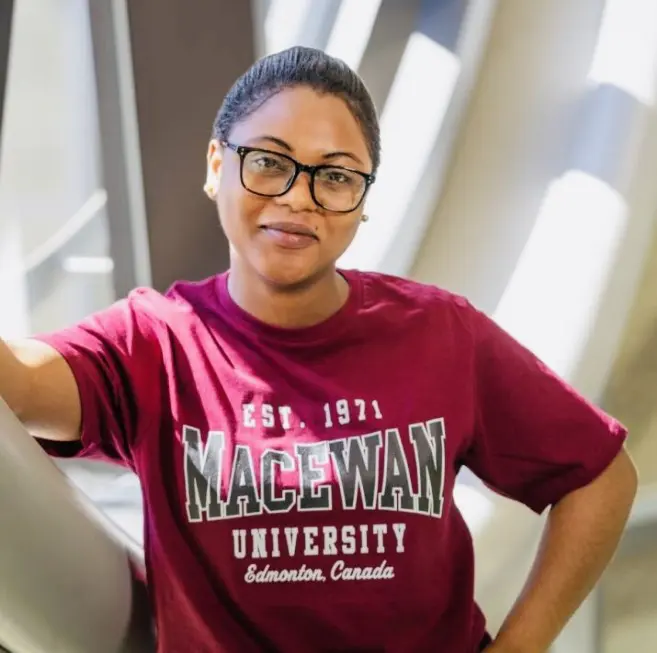
Olad Ayodeji
Running for SAMU president, Olad Ayodeji is campaigning on a platform centred around transparency, affordability, and greater student involvement in institutional decision-making.
Currently, Ayodeji serves as a students’ councillor, but she has also held roles on several governance bodies, including the Council on Student Affairs and the General Faculties Council. Ayodeji says these roles helped shape her understanding of how student representation operates at an institutional level and have given her experience in advocating for student concerns and navigating decision-making processes within the university.
Transparency
Transparency is one of the key pillars of Ayodeji’s campaign. She says she believes that students should have a clearer understanding of SAMU’s processes, including how their fees are used and how decisions are made both within the university and the students’ association.
While transparency is often discussed in relation to student finances, Ayodeji says she also sees it as a way to strengthen communication between SAMU and the university administration. From her perspective, improving transparency between the two institutions can help students better understand how decisions that affect them are made.
Affordability
Affordability is another pillar in her campaign, particularly as students face rising tuition and the financial pressures of balancing work, extracurriculars, and coursework.
Ayodeji points to her past advocacy efforts – like improving textbook affordability and lowering deferred exam fees – as examples of how student representatives can influence policy. During her time on the Council of Student Affairs, Ayodeji says student advocacy helped lower the cost of deferred exam fees from $75 to $50.
“I want students. I want it to be a collective. I want it to be a partnership.”
– Olad Ayodeji, SAMU Executive Committee Presidential candidate
Amplifying the student voice
The third major pillar of Ayodeji’s campaign is expanding students’ opportunities to participate directly in decisions that affect them. She argues that the most effective student advocacy happens when large numbers of students engage with governance processes.
She points to a previous debate at the General Faculties Council about potentially removing MacEwan’s reading week last year as an example. After thousands of students signed a petition opposing the change, reading week stayed. For Ayodeji, the experience demonstrated the power of students when they’re mobilized.
More broadly, Ayodeji says her campaign aims to position the student association as a channel to amplify student voices rather than functioning as a group making independent decisions.
“I want students. I want it to be a collective. I want it to be a partnership,” says Ayodeji.
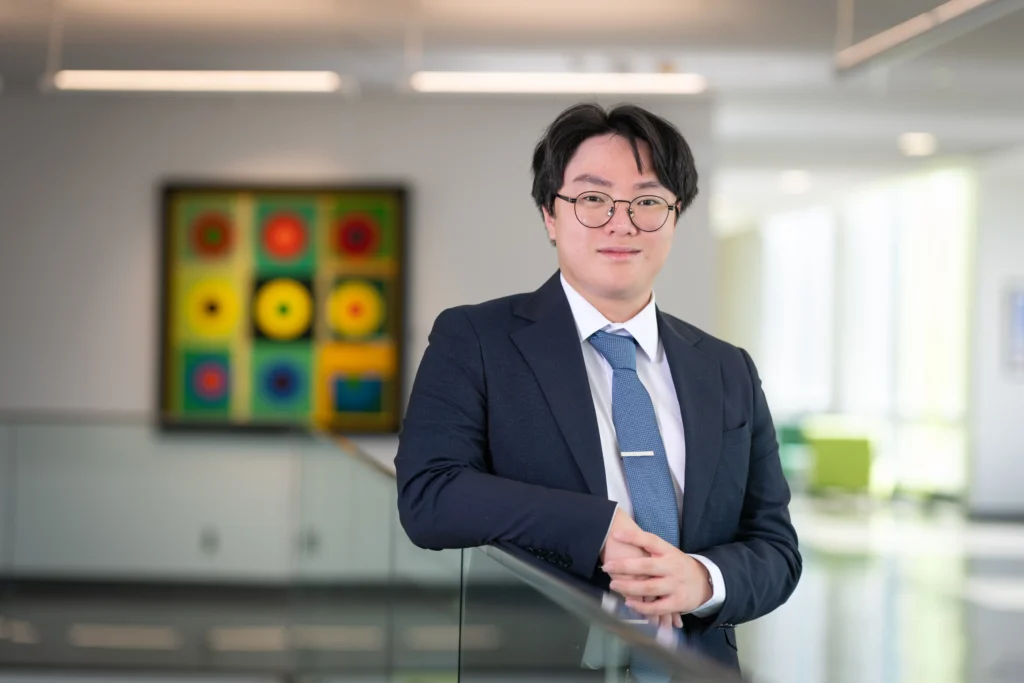
Nathan Poon
Up for re-election, Nathan Poon listed off several accomplishments throughout his term, such as increasing transparency with the executive committee’s work plan, establishing a low-cost healthy food option for students, among others. But Poon points to what he considers his greatest “intangible” accomplishment: he didn’t pander to the provincial government or MacEwan.
“Because when I look around the province, and that’s why the student movement around the province is very broken right now, because you have some student unions or some students’ associations who are selling things up,” Poon says, before immediately backpedalling.
“No, I shouldn’t say that—who compromises the student position to gain some sort of favour from the government. And we do see that quite a bit around the province, which is very unfortunate.”
When he entered his first term as president, SAMU had moved into observer status at the Canadian Alliance of Student Associations (CASA), which seeks to advocate for student needs federally, and had left The Council of Alberta University Students (CAUS), its provincial equivalent.
Poon laid out the current situation in Alberta. CAUS is in the process of dissolving, leaving some schools to join the Alberta Students’ Executive Council (ASEC) while others are going at advocacy alone.
SAMU, under Poon and his fellow executive committee, chose the last option.
As a “middle power” student association, Poon says his team has come a long way this year by advocating directly with changemakers in the political realm.
“You know, thanks to our advocacy at [Calgary] Stampede, which was led by the vice-president (external), we were able to meet with various ministers,” Poon says.
“We met with the Minister of Primary Health and Preventive Services a couple of months ago, which was an incredible meeting. We talked about, you know, work-integrated placements for nursing students.”
Transparency
Poon says that he took steps to ameliorate transparency issues in students’ council by changing the executive committee’s reporting.
Citing his previous experience as a students’ councillor, Poon says that he’d get frustrated when executive committee members didn’t submit anything unless it was deemed “strategic.” The previous strategy meant that the executive committee would say their workplan tasks were completed even when they weren’t, which left a “ gaping hole missing that the next team has to absorb.”
Instead, Poon says that when he took office as president, he made a concerted effort to ensure executive reports were submitted on time and with something to report to council.
He says he sees his role as a supportive wing to executives, although his philosophy is to get into the “nitty gritty” of things. “I have regular one-on-ones with my executives,” Poon says.
Food affordability, scholarships and bursaries
During last year’s campaign, Poon stressed the need for cheaper food options on campus. The result of this push was the creation of $5 food pop-ups on campus.
However, the $5 food pop-ups’ reliance on external partners is unsustainable, leading them to occur less often, Poon says. Throughout the year, Poon says he pushed for a permanent, healthy and dignified food option, which is close to becoming a reality. However, he says he was unable to speak more about it.
Poon says he wants to continue pushing for more affordable food options if re-elected.
Poon also revealed that MacEwan wasn’t planning to inject money into scholarships, awards and bursaries, but through one-on-ones with university leadership, the executive committee advocated for $7 million for the next fiscal year. At the moment, the money has been tabled at the Board of Governors meeting.
“You know, thanks to our advocacy at [Calgary] Stampede, which was led by the vice-president (external), we were able to meet with various ministers. We met with the Minister of Primary Health and Preventive Services a couple of months ago, which was an incredible meeting. We talked about, you know, work-integrated placements for nursing students.”
—Nathan Poon, SAMU President

Izzy Reyes
Izzy Reyes is hoping to return to student governance—this time as SAMU president— after his disqualification in the last students’ council election.
It all boils down to affordability
While students might expect candidates to have several pillars in their campaigns, Reyes’ sole focus is affordability. For Reyes, while there are other issues students face, “it all boils down to affordability.”
After a brief stint as a students’ councillor, Reyes says his experience in governance helped him realize faults in the way things are currently run, specifically pointing to SAMU’s budget, “and the way that we’re just, you know, misspending student dollars.”
“And that may not be on purpose, that may not be with any ill intent, but it’s still happening, and I want to crack down on that, tighten it, and just make sure that every student dollar is getting stretched to the most usable amount possible,” Reyes added.
Reyes cited Fall Fest’s budget, which he says costs upward of a hundred thousand dollars each year for headliners. “Do I believe that we should remove Fall Fest?” he says.
“Absolutely not. But I do believe that we can perhaps get a local artist, an up-and-coming [artist], even students. I know that we do do Battle of the Bands, but we can push that further.”
The money saved from Fall Fest could be put towards reducing student fees, which he says: “even if we’re saving a student a buck, a buck per head, I don’t mind— every single dollar saved is a win in my books.”
Lessons learned from the last election
Reyes reflected upon his disqualification in the last students’ council election, in which he was disqualified for his “provocative” and “suggestive” campaign posters, according to Reyes’ Instagram story last October.
Reyes says he learned he needs to continue being on top of things, adding that he needs to be wary of the “fine print in policy” and prepared to defend his campaign against any attacks.
“I believe that it’s taught me a good lesson, and I’m ready to go forward with new professionalism and a newfound sense of control,” he says. Reyes revealed that he was the first candidate to get posters and other campaign materials out. He says he has prepared in advance for campaign deadlines and responses to questions during tablings and interviews.
If elected, Reyes would consider his term a success if he sees tangible reductions in student fees.
“Why should students vote for me?” Reyes says.
“I think throughout this interview, I’ve tried to convey it, but simply because I believe that I want it more than anybody else, and to that extent, I believe that I will perform my duties to that extent, because if I’m willing to take the stance that I do publicly, if I’m willing to put in the sort of hours that I do, I believe that I can show up for my student body and make them proud.”

0 Comments