
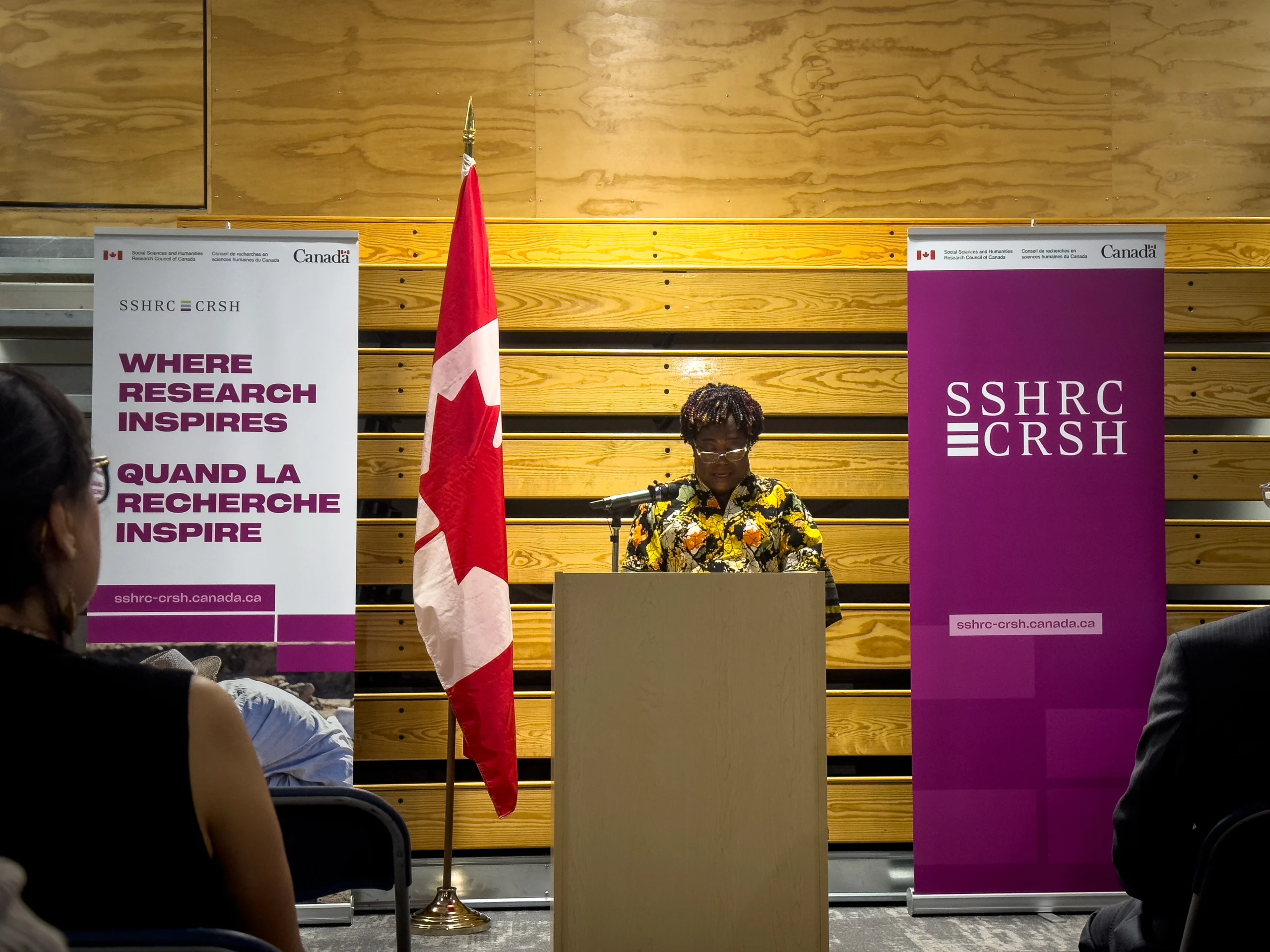
The federal government announced just under $290 million in funding for social sciences and humanities research today at MacEwan University, with several university researchers receiving grants to cover topics including health equity, education, emerging technologies, climate adaptation, and social justice.
Karim Bardeesy, Parliamentary Secretary to Minister of Industry Mélanie Joly, announced that the money will support 1788 research projects and partnerships through the Social Sciences and Humanities Research Council (SSHRC). According to the federal government, the funding will help address social, economic, and cultural challenges while supporting research at universities, polytechnics, and colleges across Canada.
Bardeesy said the funding reflects the federal government’s commitment to research at a time when it is increasingly under pressure globally.
“I’m so proud to be here as part of the government that made major investments in the 2024 budget, and science and research,” he said, adding that social sciences and humanities research helps Canadians “understand who we are” while contributing to a more inclusive and prosperous society.
Among the projects is a new Partnership Development Grant led by Dr. Mary Asifiri, an assistant professor in MacEwan’s faculty of nursing. Her three-year project received the full $198,835 requested and will work to examine anti-Black racism experienced by Black students in nursing, medicine, and social work programs across Canada.
“Anti-Black racism is not confined to nursing alone. It affects Black learners across healthcare professions, such as medicine, social work, and beyond,” said Dr. Asirifi.
The study will bring together researchers and community partners from Alberta, Ontario, and Newfoundland to develop an educational toolkit to address anti-Black racism in healthcare education. The project will also provide research opportunities for undergraduate and graduate students from racialized communities.
SSHRC COO Sylvie A. Lamoureux said the announcement demonstrates that research excellence extends beyond Canada’s largest research-intensive universities.
“Research excellence exists across Canada’s post-secondary ecosystem.” Sylvie A. Lamoureux, COO and vice-president (research) at the Social Sciences and Humanities Research Council (SSHRC).
“Research excellence exists across Canada’s post-secondary ecosystem,” said Lamoreux, noting that undergraduate-focused institutions like MacEwan play an important research role alongside colleges, CEGEPs, and polytechnics. She added that the latest funding includes three Insight Grants – focused on advancing the knowledge of people, the world, and society – and five Insight Development Grants – focused on supporting research in its initial stages – led by MacEwan researchers.
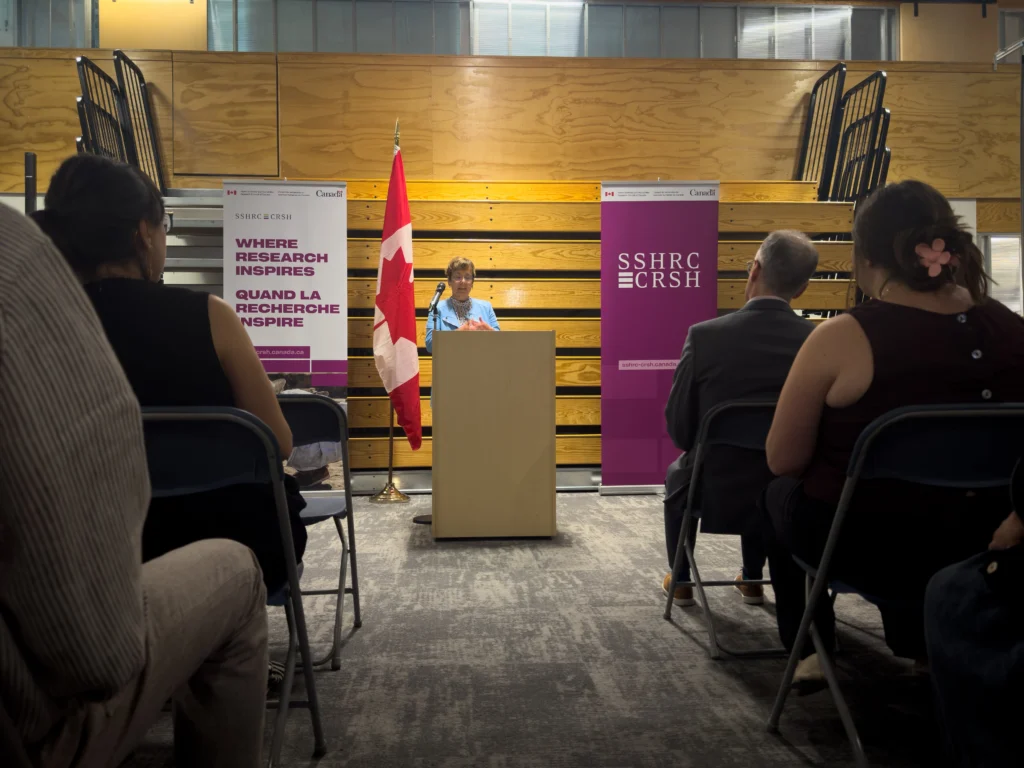
MacEwan president and vice-chancellor Dr. Annette Trimbee said the university has significantly expanded its research capacity in recent years while maintaining its teaching-focused mission.
“We believe research and teaching go together. Research makes us better teachers,” she said.
Dr. Trimbee highlighted that SSHRC funding awarded to MacEwan researchers has grown from roughly $300,000 five years ago to approximately $3.5 million this year. She added that the university offered 362 student research assistantships last year, and that MacEwan is now working toward a goal of 500.
Following the announcement, Dr. Trimbee said that undergraduate research experiences are central to MacEwan’s strategic direction, allowing students to develop critical thinking skills while contributing to meaningful research alongside faculty members.
“I think it’s really exciting, and I want that to be the norm rather than an exception,” she said.