
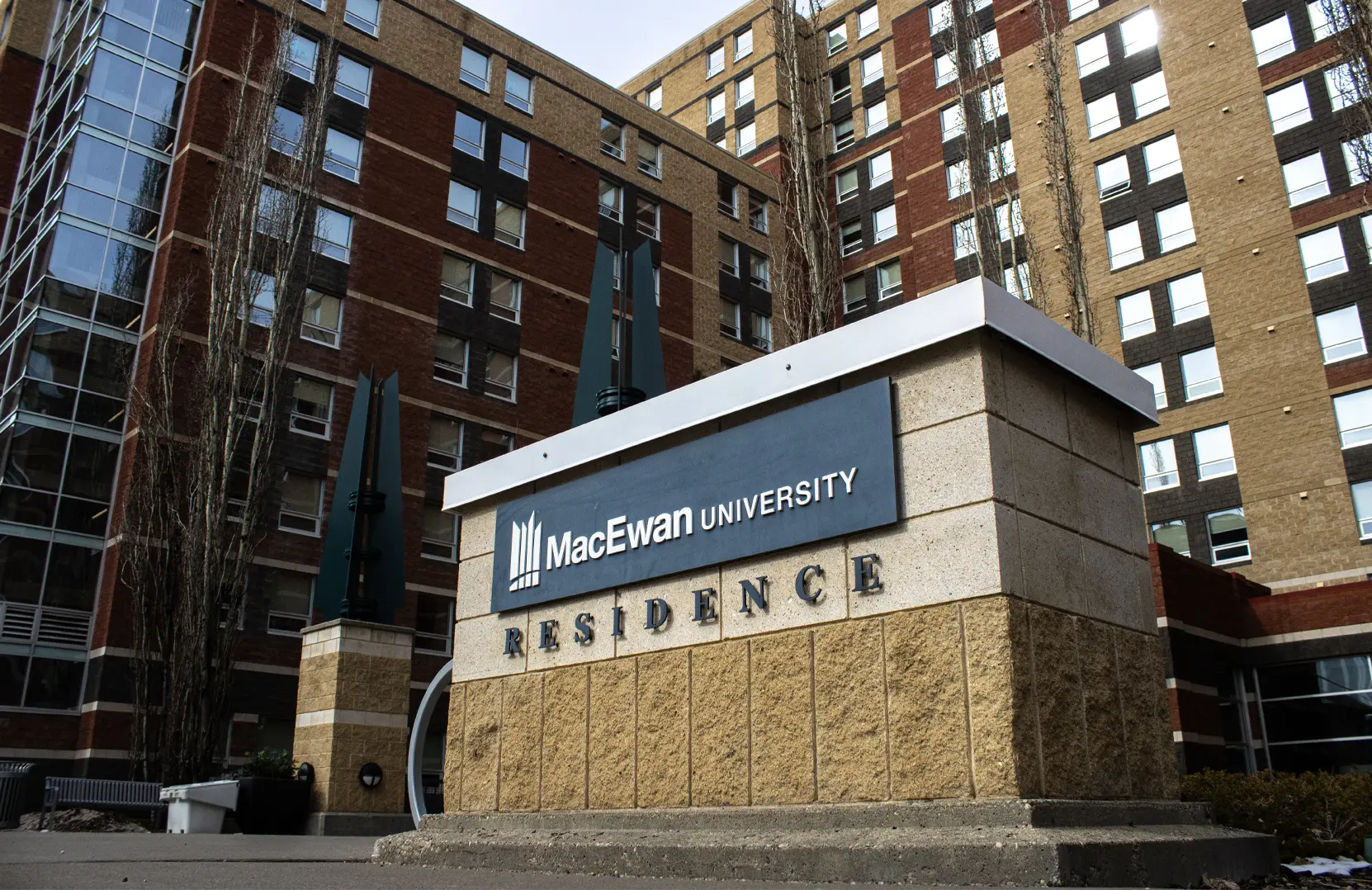
MacEwan residents are concerned about the lack of communication from the school
Krys Doblanko was caught off guard by MacEwan’s email.
“Just a quick note to let you know that room rates for the 2026-2027 academic year have now been approved and posted on our website,” the email read. “You can visit our Compare Costs webpage to view the rates.”
Nonchalant and ambiguously worded, the email frustrated Doblanko, a design studies student.
“My initial reaction was, obviously, first I was upset because I had applied back in October for the next year,” said Doblanko.
“And then now they’re just telling us this news, and I just felt as if I wish I learned earlier, because I know a lot of students are on a tight budget, so it’s just frustrating to learn that they’ve increased this, not suddenly, but without planning.”
After doing some research, Doblanko found out that residence fees were going up by about $350 for an eight-month stay, and by $500 year-round.
“I don’t think it’s fairly affordable. And now I think that is a problem with universities as a whole. There’s a big problem with affordability there. But I don’t think MacEwan is necessarily living up to its promises.”
— Lee Dominaux, second-year MacEwan student
Doblanko, like many other MacEwan students, lives on a tight budget. Student loans—capped off at $17,000 for two semesters for students in a Bachelor’s degree program— can help cover tuition, textbook costs and other school-related fees, but the money left over provides little financial breathing room amidst the ever-rising cost of living.
Hence, MacEwan Residence is a blessing for some students.
“What attracted me so much about MacEwan’s residence was the price,” said Viola Conner, a first-year student. Close to the university and with amenities such as a private bathroom and kitchen, the residence seemed ideal for Conner, who moved to the city for school.
“But if [MacEwan’s] increasing it, and I’m not really getting anything more for the increased price, it’s frustrating,” she added.
Conner worked two jobs since grade nine because she always knew she would have to pay for her schooling. But even with a hustle mindset, Conner still took out student loans to supplement her finances.
“With some student loans, I did have money left over, but I don’t know that, as someone who had to pay for it on my own, if I hadn’t been breaking my bones working, I don’t know that I would have been able to have afforded residence,” Conner said.
“What attracted me so much about McEwan’s residence was the price, but if [MacEwan’s] increasing it, and I’m not really getting anything more for the increased price, it’s frustrating.”
— Viola Davis, first-year MacEwan student
Across Canada, students rely on cheap housing, regardless of the quality. Lee Domineaux grew up in Newfoundland and moved across the country to attend MacEwan, even though Memorial University of Newfoundland (MUN) was closer.
According to Domineaux, the state of MUN’s residence made MacEwan’s residence “look like a four-star hotel.”
Domineaux said his friends in Newfound were shocked when he showed them a picture of MacEwan’s residence—a residence that provided students with their own bedroom, shower, and kitchen.
Domineaux said he looked at the major schools in Edmonton and ended up at MacEwan, the middle-ground school that prides itself on affordability.
“I don’t think it’s necessarily affordable,” he said. “And now I think that is a problem with universities as a whole. There’s a big problem with affordability there. But I don’t think MacEwan is necessarily living up to its promises.”
Even though Domineaux feels let down by MacEwan, he and Doblanko, the design student, ask MacEwan for clarity—clarity about why fees are rising.
The Griff posed questions to the university to clarify when it approved the residence fee increases, why fees are going up, how it informed students, how residence fees are set and where the money goes.
The email response, from acting associate vice-president (campus services) Wendy Brost, stated that the university decided to raise fees last November.
“There has been no increase for 10 years, despite rising inflation, labour and operating costs. Even with the slight increase for fall 2026, we remain far below market value,” wrote Brost.
“The new rates are communicated to students applying to live in residence for fall 2026. 100% of student rent money goes entirely to the operations of the residence: staffing, operations and infrastructure costs.”
However, Doblanko has further concerns and questions about MacEwan’s response.
“We were told in February, after students paid to re-apply for residence. If you had approval for these price increases in November, why wait to announce it? Was there a delay, or did you want to wait and see if there was further developments?” Doblanko said in a Discord message to The Griff.
“The email we got just outlined that there was a change. Not by how much, not saying the reason why. There wasn’t even a follow-up email regarding it.”
“If that is the level of communication between faculty and students, something needs to change so everyone can understand what is going on.”


0 Comments