
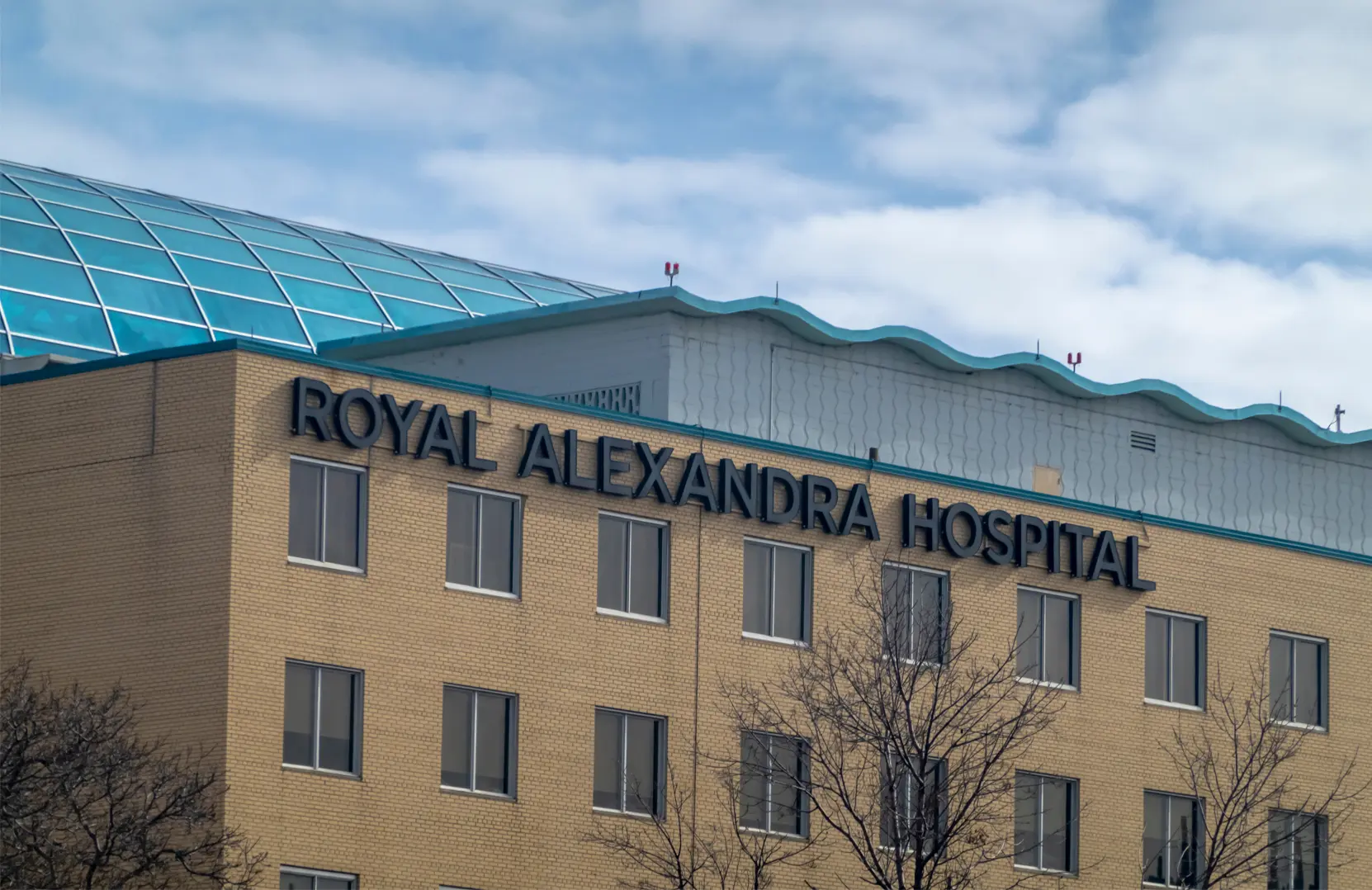
Photo courtesy of Oasisamuel on Adobe Stock
The site was the first hospital-based supervised consumption site in North America.
The closure of the supervised consumption site at Edmonton’s Royal Alexandra Hospital has become a focal point in Alberta’s shift toward recovery and abstinence-based models of addiction care. The site, located in one of Edmonton’s highest-need neighbourhoods, served hospitalized patients who use drugs.
The Alberta government has framed the closure as a response to underutilization, stating that resources will be directed toward recovery-oriented services. The decision comes as the province continues to experience rising drug poisoning deaths, prompting renewed scrutiny of how addiction and public health services are structured.
The Royal Alex site opened on April 2, 2018, becoming the first hospital-based supervised consumption site in North America. Approved under federal exceptions granted in October 2017, the site operated 24 hours a day and could accommodate up to six patients simultaneously. Access was limited to hospital inpatients, and supervised injection, nasal, and oral intake was permitted – no inhalation was allowed.
Dr. Kathryn Dong, who helped establish the site, says it was created to address gaps in hospital-based care that had been identified through research, community advisory, and long-standing partnerships with people who have lived experience of substance use and structural marginalization. At the time of its establishment, Dong was the medical lead for the Addiction Recovery and Community Health program (ARCH).
“You know, in particular, when people come into hospital, they’re often removed from their usual environment where there may be safety plans in place to ensure that someone was around or able to respond in an overdose or drug poisoning setting,” Dong says, explaining that hospital settings present unique risks for people who use drugs.
She adds that stigma within healthcare settings was a significant concern during the development of the site.
Because the site operated within a hospital, substance use was documented in patients’ confidential medical records – something Dong acknowledges could deter some people from using the service. To address concerns about surveillance and trust, Dong says that the service was co-designed with the community advisory group and emphasized transparency throughout the consent process.
“So when we don’t have services like this for people that do continue to use drugs, there is the risk that they will use in an unsupervised way and have a drug poisoning episode and not be found in time to provide care.”
Dr. Kathryn Dong
The supervised consumption service also provided legal protections under the Health Canada exemption, Dong says.
“So when you have that exemption by Health Canada that comes with an exemption from the criminal code. So that for people who stored their substances in the designated area, which was a bedside safe, and only transported it to and from the supervised consumption service, there was protection for patients,” Dong says. She adds that there were also protections for hospital staff who may have to secure substances that were left behind.
While the site permitted supervised injection, it did not allow inhalation. Dong says that decision reflected both funding limitations and patterns of drug use at the time.
“At the time, injection was the primary route of concern for our community advisory group. We did not initially have funding to build the infrastructure that was required for supervised inhalation in the location where the service was located,” says Dong.
She adds that shifts in drug use during COVID-19 later made the lack of inhalation services more apparent.
“If I could go back, I really wish we had it all from the beginning,” says Dong.
The Nov. 19, 2025, closure follows policy changes introduced after the United Conservative Party formed government in 2019. The province immediately froze funding for new supervised consumption services and launched a review of existing ones. The review committee later said it was concerned about “a lack of focus on referrals to recovery-oriented services,” among other concerns.
Karen Kuprys, chair of Friends of Medicare, says gaps in Alberta’s current response to drug poisonings extend beyond individual programs.
“Well, it’s lack of capacity and supports,” says Kuprys, explaining that access to good food, nutrition, and safe housing can support those along the path to recovery and prevent drug use in the first place.
Kuprys also points to structural changes in service delivery surrounding the province’s direction in public health and addictions care.
“Since establishing Recovery Alberta, the provincial government has pursued their ideological approach to addictions care,” says Kuprys. She also highlights how there is “considerable evidence” against recovery-only services.
Studies have shown that supervised consumption services not only prevent drug poisonings on site, but also help to connect people who use drugs to healthcare and addiction treatment programs. Research from British Columbia has found a nearly 5 per cent increase in treatment engagement after overdose prevention sites opened. According to a 2025 review in the Harm Reduction Journal, harm reduction interventions such as supervised consumption sites reduce the risk of serious infectious diseases like HIV and hepatitis C, increase access to medications for opioid use disorder, and facilitate ongoing engagement with health and social services.
Dong says the absence of hospital-based supervised consumption services can create serious risks.
“So when we don’t have services like this for people that do continue to use drugs, there is the risk that they will use in an unsupervised way and have a drug poisoning episode and not be found in time to provide care.”
She also says patients may leave the hospital to use substances offsite, sometimes without a bed to return to, as hospitals can only hold beds for so long.
Between 2019 and 2025, there were 12,439 unique individuals accessing supervised consumption services connected to Edmonton’s hospital and overdose prevention infrastructure, according to the Alberta substance use surveillance system. Annual unique visitors peaked in 2019 at 2,334 before declining during the COVID-19 pandemic and following the staggered closure of multiple sites across the city.
The decline in supervised consumption service use has occurred alongside a sharp rise in drug poisoning deaths. Provincial data shows that deaths per 100,000 people nearly doubled between 2019 and 2024.
Dong says the service was born out of an obligation to provide safe, evidence-based care within hospital settings.
“It existed because there was clear evidence of a need for this type of service from the patients that we serve, and because people who use drugs deserve healthcare that’s safe and that meets their needs just as much as anybody else.”
The closure leaves Edmonton with two supervised consumption sites: the George Spady Centre and Radius Community Health. Neither replicates the inpatient-only, hospital-based model that existed at the Royal Alexandra Hospital.
“The Alex is a large downtown hospital, and there was a need for this service,” says Dong. “So it will definitely be missed by our entire hospital.”


Great article.
The need for wraparound care increases.
Thank you for this! Hope we see it back in the Alex one day.