
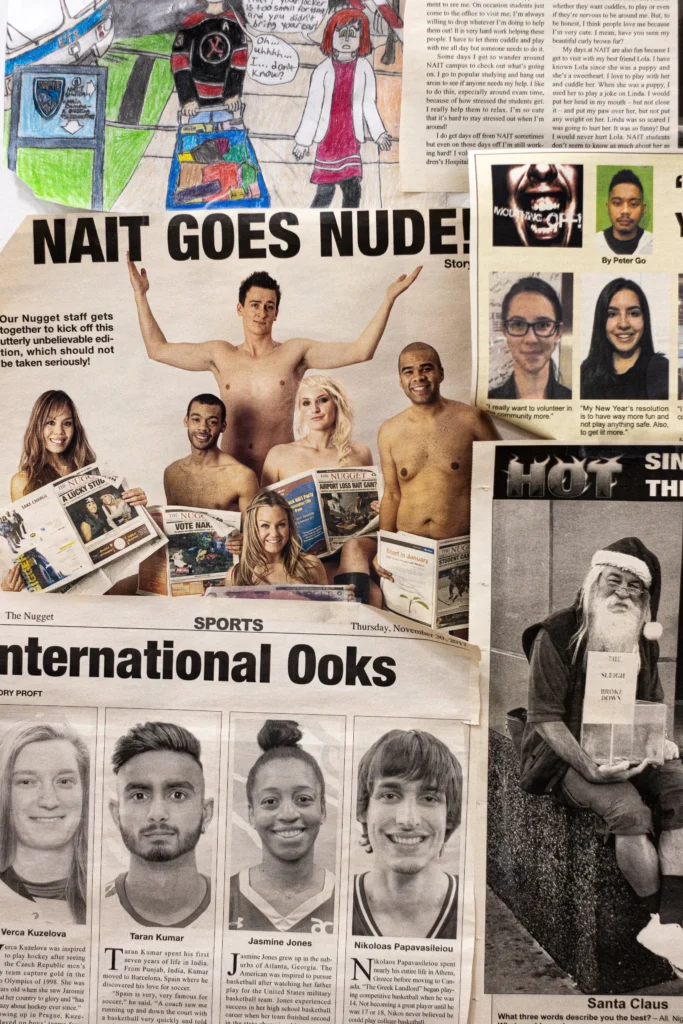
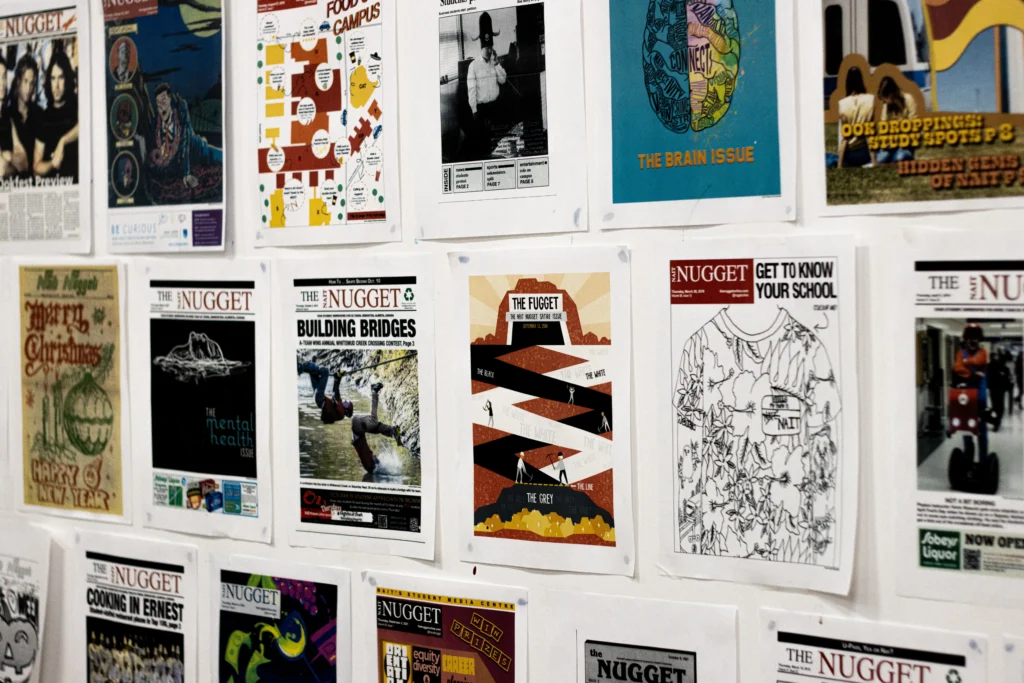
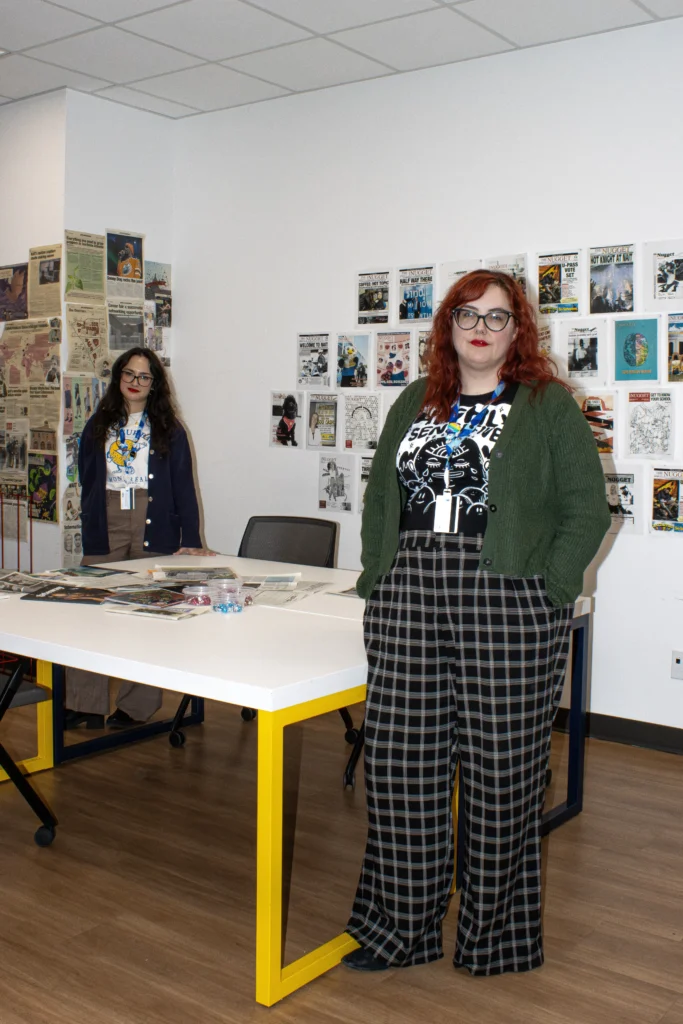
Old covers of the NAIT Nugget stuck to the wall of the Nugget’s office. Amanda Erickson/The Griff.
In a world where getting your news often means checking your phone, some publications are still pushing papers around their neighbourhoods.
Hyperlocal news in Edmonton doesn’t always resemble a traditional newsroom or a website with daily updates. More often, it looks like a volunteer dropping off a bundle of neighbourhood newsletters at the post office, or a student editor piecing together articles after a day of class. In a city where local print journalism has thinned, these tiny, often-overlooked publications have become the glue that keeps communities connected and informed.
The lost ones
Over the last decade, Edmonton has witnessed the decline of small publications. The Yards, once a staple voice in the central Edmonton community, which serviced more than 24,000 mailboxes in the Wîhkwêntôwin and downtown areas, ceased publication as of 2021. The magazine carved out space for hyperlocal storytelling and neighbourhood identity, focusing on current events and urban planning in Edmonton’s downtown. VUE Weekly, which began publishing in 1995 as a weekly alternative newspaper, aimed to cover stories that were overlooked or misrepresented. It ceased publication in November 2018. VUE president Robert Doull explained in an interview with Global News that “the support for an alternative weekly in the Edmonton market has been declining for several years.” Rather than watch the paper struggle under “diminishing resources,” VUE shut down entirely in a loss that symbolized the shrinking ecosystem for independent local print media.
Community league papers
The Westmount Window is a quarterly 48-page magazine published by the Westmount Community League, for the Westmount community. It features advertising from the local business neighbors, with a mix of local stories, civic issues, and creative work. The Westmount Window values inclusion. There are no required skills to contribute, and all voices within the community are cherished. Their goal is to help people understand and empathize with others.
“We really want this magazine to be a publication that everybody in Westmount can kind of see themselves in, and that includes people who have very different political views than mine.” says Jay Summach, editor-in-chief of the Westmount Window.
Summach leads the publication completely in his spare time. Entirely volunteer-run, the publication is funded by advertisements from business partners.They break even on the entire production and don’t make a profit. A consistent writing team fills the pages with their stories.
This team includes a historian, so the Westmount Window is also able to produce historical stories about the Westmount community. Summach uses the metaphor of zoo animals to explain why the history is so important; before you can care about protecting an animal, you must first learn to love the animal, and understand it.
“I think people care about people when they know something about the people. They care about neighborhood history if they know something about the history.”
Summach says his priorities lie in future-proofing the publication. While volunteers assist in writing and photography, Summach does most of the back-end work by himself. This includes the layout and design of the publication, as well as advertising and invoicing. Summach also illustrates most of the publication, and takes on the bulk of the editing process. In order for the next team to take over production, the process needs to transition, so that more people are involved in the leadership roles.
“That’s a pretty quirky skill set, and it takes somebody who is enough of a nerd that they like doing those things and stupid enough to keep doing it over and over again. I guess what I’m saying is it takes a bit of a unicorn at the center of a lot of gifted people to help make it happen.”
In the digital era, a lot of news and media have turned to digital platforms. Summach explains that a lot of this content comes from many different places. Much of our media comes from the United States, and local printed media offers something that’s much more focused on our own communities.
“With this magazine, it’s a different format, it’s a different channel of delivery. It’s immediate in my hands and it’s also immediate to my lived experience. And I think somehow, people get that,” says Summach.
“It takes a bit of a unicorn at the center of a lot of gifted people to help make it happen.”
— Jay Summach, editor-in-chief of the Westmount Window
Calder Publications, which produces Castle News along with three other league-based newspapers, has been in operation since 1994. Founder Hugh Calder says the model succeeds because it’s deeply embedded in Edmonton’s community league system. These papers connect dozens of neighbourhoods together through their printed papers, offering everything from recreation updates to construction notices to small-business advertising targeted to specific districts in Edmonton.
Calder Publications’ work is built on a close partnership with these leagues. Each community league has its own volunteer newsletter editor, responsible for gathering program updates, event listings, meeting notes, or neighbourhood concerns. Rather than handling layout, printing, and delivery on their own (tasks that often strain volunteer capacity), leagues send their content directly to Calder Publications. That content is then compiled to begin the designing and preparation process of each issue.
“Newsletter editors were getting to a point they were frustrated,” says Calder. He explains that it was difficult for community leagues to find volunteers because the weight of putting together these newsletters lay solely on them.
By centralizing the production process, Calder Publications became, as Hugh put it, the “bad cop” of deadlines, which ultimately improved consistency of the newsletters and took that burden off the volunteers.
Once the paper is finalized for each region, Calder Publications handles printing and coordinates mass distribution through Canada Post, ensuring every one of the 73,000 households they serve receives the same information.
“Everybody in that area is getting the newspaper,” says Calder. “They’re all sharing the same information, and that’s crucial.”
This consistency is a key aspect of the system’s strength. A recreation announcement in one neighbourhood may be relevant to the next, and a zoning change affecting one block might matter to families several blocks away. The structure enables community leagues to operate more as an interconnected network, sharing concerns, solutions, and opportunities with one another through printed news.
Student journalism
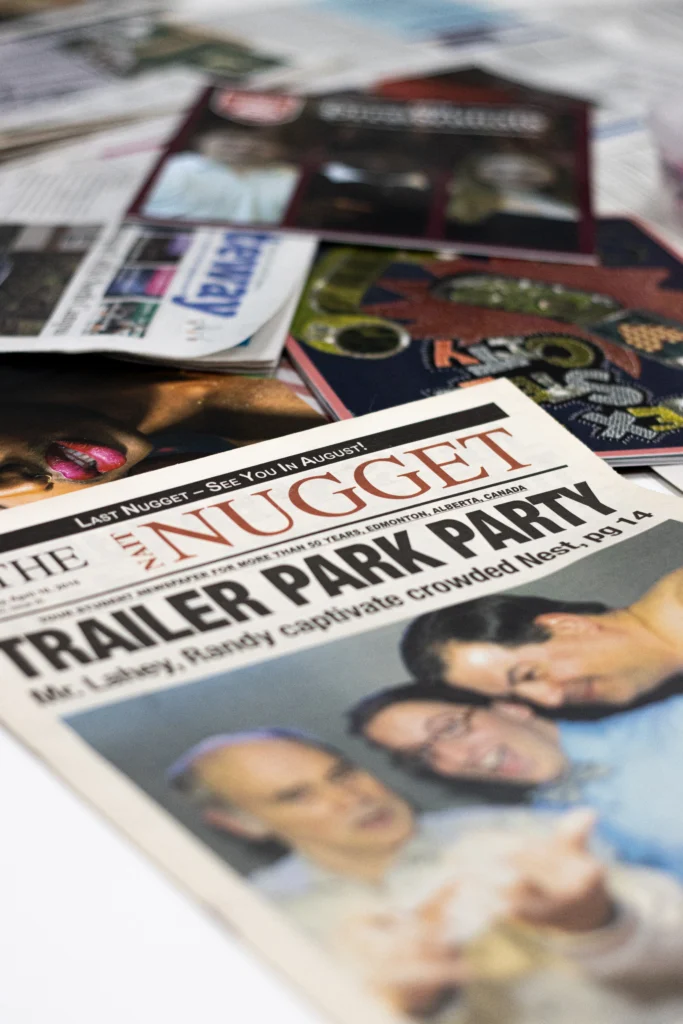
If neighbourhood papers are built on volunteerism and community, the NAIT Nugget is built on a belief that student journalism still matters. For editor-in-chief Amy St. Amand and senior editor Alleah Boisvert, that commitment is obvious. They describe the Nugget as “community journalism,” with their community being NAIT. The paper covers everything from student life to institutional accountability, including their reporting on NAIT’s $25,000 presidential bathroom soundproofing – a story that no mainstream outlet touched.
“Nobody’s covering the stuff that we cover, right?” says St. Amand, noting that student papers often fill gaps left by Edmonton’s major media outlets.
The Nugget also serves a second function: identity building. NAIT’s student population includes apprentices who are on campus for only a few weeks at a time, international students navigating a new environment, and learners in fast-paced technical programs with only a short period of time to participate in campus culture. Boisvert and St. Amand both emphasize that part of their mission is helping students connect with the publication by showing them the value of in-print reporting. Improving skills, building community, and meeting people who share interests are a large part of the Nugget’s goal.
“I mean, when I was a student before I worked at the Nugget, when I saw a new issue on stands, even if I didn’t plan on reading it, I would just grab it,” says Boisvert.
Print publications, the editors emphasize, are forever. It serves as a historical record – immune to quiet edits and algorithmic pressure.
“In the age of digital journalism, I can easily go back and change facts or correct something or just go rogue and completely change it,” says St. Amand. “But print is forever. Once it’s printed, it’s there.”
At the University of Alberta, the Gateway is navigating its own period of renewal. Now 115 years old, the student publication serves as both a newsroom and a training ground in a school without a formal journalism program. This dual identity is a core part of the Gateway’s mission, as editor-in-chief Leah Hennig sees it.
“We cover things that are happening on campus, you know, all the news that doesn’t get covered elsewhere,” says Hennig. She explains that the Gateway works to fill the gap in skills, training, and familiarity with different sections of the publication that students would otherwise be missing out on.
In the 2020-2021 academic year, the Gateway lost its Dedicated Fee Unit (DFU), which is a student fee used to fund the publication. This pushed the organization into deficits and forced major staff and equipment cuts. Hennig remembers first volunteering during that period and realizing just how precarious it was for the publication. She says that, as a volunteer, she understood that the Gateway was facing a complete shutdown if that funding didn’t return.
In 2024, their funding returned in the form of an opt-out undergraduate DFU paired with other income sources, such as government grants, advertising, and merchandise sales. Now, the Gateway is adding new reporting positions, replacing outdated equipment, and has written its first five-year strategic plan focused on long-term stability for the publication. Part of that work includes repairing relationships on campus, particularly with Indigenous groups, which Hennig says the Gateway historically did not cover well.
“So we’re trying to, you know, like, make sure we’re keeping open communication with them. We’re paying attention to what they’re doing, and they feel like they can come to us as well,” says Hennig.
The publication has also reintroduced print editions, which have been met with unexpectedly high enthusiasm.
“We’re doing a monthly print now, and the reactions have actually been really good,” says Hennig. “Like, people really enjoy having that as a cool addition.”
Looking to the future, Hennig hopes to continue expanding coverage and experimenting with new forms of storytelling, such as short-form video, which the Gateway is exploring on its social media platforms, to “reach more people and kind of meet the demand where it is,” as Hennig puts it.
And that’s why hyperlocal news matters
These papers, whether seasonal, student-run, or delivered by Canada Post, keep neighbourhoods informed in ways that no algorithm can. They highlight local businesses, share the victories and struggles of nearby residents, and record the stories that would otherwise disappear in the internet ether. Hyperlocal publications remind readers that their immediate world still matters. The block they live on, the school they attend, and the issues that affect only a few thousand residents are rooted in the community.
They prove that print isn’t dying. It’s simply becoming more personal.
Correction Jan. 15, 2026: The original version of this story incorrectly stated that the Gateway’s DFU was opt-in. This story has been edited to state that it is actually opt-out.


Thanks so much to the folks at the Griff for covering this!
Good article (and story idea), Amanda. It’s important to highlight these small, but significant news sources.
Good article, however Calder Publications will no longer exist in 2026.