
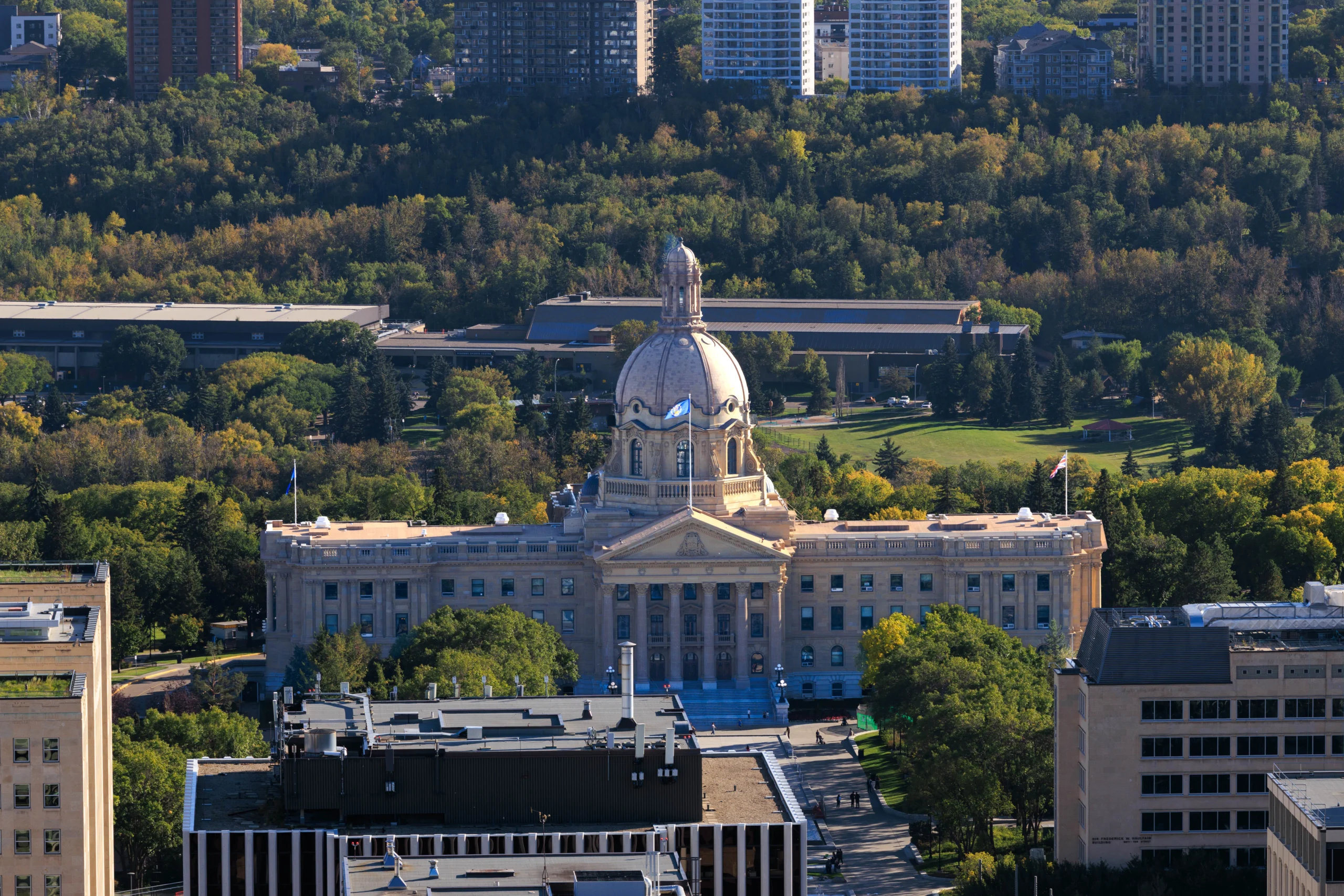
The Government of Alberta is considering new institutional neutrality requirements that could expand the province’s control over publicly funded post-secondary institutions, such as universities.
According to the Students’ Association of Mount Royal University (SAMRU), the Ministry of Advanced Education has discussed potential measures, including ministerial approval of institutional policies, annual reporting, and restrictions on public statements by governing board members and senior administrators. The proposal stems from recommendation 11 of the Mintz Panel report, which calls for institutional neutrality, freedom of expression, and intellectual diversity.
While the province has consulted with student associations and union representatives, it has yet to clarify how the proposed requirements would be defined, implemented, and enforced.
In a statement to the Griff, Minister of Advanced Education Myles McDougall confirmed that the province is assessing potential legislative changes.
“As outlined in my mandate letter, I am working with the Minister of Justice to assess the need for legislation that would protect academic freedom and freedom of expression for students and faculty at Alberta’s post-secondary institutions,” McDougall said.
“This work is underway, and further details will be provided when decisions have been made.”
Proposed funding changes
As previously reported by the Griff, the Mintz Panel recommended sweeping changes to Alberta’s post-secondary education funding system, including the introduction of a new framework based on enrolment, institutional performance, and operating costs.
In September, the University of Calgary’s student paper, the Gauntlet, obtained Ministry of Advanced Education presentation slides outlining a proposed funding and tuition framework presented to student leaders in late August.
According to the Gauntlet, the proposed framework would group post-secondary programs into five clusters based on factors such as labour market demand and program costs, with varying levels of government subsidies. The documents also indicated that the ministry was considering replacing annual tuition increase limits with maximum tuition levels set by the minister, with a potential transition beginning in the 2027/28 academic year.
The Students’ Association of MacEwan University (SAMU) has also raised concerns about how the proposed performance-based funding model could interact with institutional neutrality requirements.
“The tuition fees consultation from our end is likely being eliminated.” — Nathan N. Poon, SAMU president
SAMU president Nathan N. Poon says the association is concerned that institutions could face financial consequences for taking positions on social or political issues that the provincial government considers outside their educational mandate.
“We’re worried that those sorts of social issues that MacEwan or institutions around the province try to raise is going to be a catalyst for the province to try to pull funding away from the institution overall,” said Poon.
While the ministry has not confirmed that institutional neutrality would be tied to funding decisions, SAMU is concerned that performance measures, including community impact, could create opportunities for the province to penalize institutions over their positions on social issues.
SAMU also raised concerns that the proposed tuition framework could eliminate existing requirements for universities to consult with student representatives about tuition fees.
Under the current process, the SAMU said it is required to meet with the university twice regarding tuition fees, providing students with an opportunity to participate in decisions affecting the cost of their education.
Poon said SAMU believes this consultation process could be removed under the proposed changes, describing it as an important mechanism for student representation that should be maintained.
“The tuition fees consultation from our end is likely being eliminated,” said Poon. “That’s something we do value as a students’ association.”
Anna Dau, president of the Students’ Association of Olds College, said funding is a primary concern for their institution, particularly given its smaller student population and extensive agricultural facilities.
“We have a very low enrolment compared to some of the other schools, but we have a lot of buildings because we are an agricultural school,” Dau said, pointing to machinery shops, livestock facilities, and higher maintenance costs.
Dau said these expenses have not always been adequately reflected in institutional funding and emphasized the importance of considering campus infrastructure alongside student enrolment.
Concerns about institutional neutrality
While much of the Mintz Panel’s report focuses on funding, its recommendations also extend to institutional governance and academic freedom.
The report also raises concerns about certain diversity, equity, and inclusion practices, while explicitly stating the recommendation should not detract from initiatives supporting Indigenous students.
According to Mariana Mejia Salazar, vice-president (external) of the Students’ Association of Mount Royal University’s (SAMRU) representation executive council, the Ministry of Advanced Education provided a working definition of institutional neutrality during an Aug. 27 consultation with student representatives of all 26 publicly funded institutions in Alberta.
Mejia Salazar said the ministry defined neutrality as “the principle that a post-secondary, as an institution, must refrain from issuing statements or taking positions on political or social issues that do not directly affect its institutional mandate.”
However, she said the consultation left student representatives with questions about how the proposed requirements would differ from existing policy.
In 2019, Alberta’s publicly funded post-secondary institutions were required to adopt the University of Chicago’s principles on free expression or develop policies consistent with them. Additional reporting requirements concerning campus free speech were introduced in 2023.
SAMRU has since called on the ministry to demonstrate why additional regulation is necessary before proceeding.
SAMU has raised similar questions about whether institutional neutrality could restrict universities from publicly recognizing events or initiatives related to social issues.
Poon pointed to MacEwan University’s Pride Week celebrations and recognition of Truth and Reconciliation Day as examples of activities that could be considered political or social statements under the proposed framework, potentially discouraging institutions from hosting or supporting them.
Although the province has not indicated that such events would be prohibited, Poon questioned how universities would determine which activities fall within their institutional mandates and whether the government’s interpretation could differ from that of individual institutions.
Student representative seeks clarification
On Sept. 22, SAMRU submitted a 14-page response to the Ministry of Advanced Education outlining nine recommendations concerning the proposed neutrality requirements.
The submission calls for clear definitions of neutrality, protections for academic freedom and institutional autonomy, safeguards for existing student supports, and further consultation with student representatives before implementing any neutrality policy.
Mejia Salazar said student representatives were given an opportunity to ask questions during the August consultation session, but several concerns remain unresolved.
She described questions raised during the consultation about whether teaching subjects such as critical race theory would require institutions to provide opposing perspectives, or whether existing courses might need to change.
“There’s a course that we teach here on campus called ‘The Holocaust,’ and it speaks about the Holocaust,” she said. “So, would we also need to teach about the Holocaust deniers? Is that something we need to do?”
“And what is freedom of speech? Who are the people that we are protecting under this? How can we determine what is a safe space, and by whose standard is that?”
According to Mejia Salazar, the ministry did not provide clear answers about how neutrality would apply to these circumstances.
“The ministry just said that they would just want to make sure that people feel safe to share in the classroom,” she said, adding that ministry officials were still considering what that would mean.
SAMRU’s submission argues that academic freedom must continue to protect curriculum development, research, teaching, and the examination of controversial subjects.
It also warns that a neutral learning environment should not be interpreted as one free from disagreement or intellectual discomfort.
Another concern involves the potential impact on equity initiatives and targeted student supports.
SAMRU has asked the province to ensure that requirements do not interfere with “institutional responsibilities relating to human rights, accessibility, reconciliation, Indigenization, and evidence-based student services.”
“One of the biggest ones that we’re most concerned about is our ask number five,” Mejia Salazar said, referring to the protection of these responsibilities.
The submission emphasizes that politically controversial issues are not necessarily outside a university’s institutional mandate.
“And what is freedom of speech? Who are the people that we are protecting under this? How can we determine what is a safe space, and by whose standard is that?” – Mariana Mejia Salazar, SAMRU vice-president (external).
Questions about institutional autonomy
The potential requirements have raised concerns about how much authority the provincial government could exercise over university governance and independent student advocacy.
Ministerial approval of institutional policies could introduce additional government oversight into decisions currently made by universities, while annual reporting requirements could increase administrative responsibilities.
These measures could also conflict with other recommendations in the Mintz Panel report.
Recommendations eight and nine call for greater institutional autonomy and reduced administrative burdens, respectively.
Mejia Salazar questioned how additional government oversight and reporting requirements would align with those objectives.
“Our overall takeaway is that the ministry is seriously considering moving forward with institutional neutrality.” – Mariana Mejia Salazar, SAMRU vice-president (external).
Restrictions on public statements by governing board members and senior administrators could also affect student representatives who sit on university boards while advocating on behalf of their students’ associations.
SAMRU argues that any neutrality framework must distinguish between statements made on behalf of an institution and independent advocacy undertaken by elected student representatives.
SAMU echoed these concerns, warning that restrictions on governing board members could create uncertainty for student, faculty, and staff representatives who are responsible for bringing their respective communities’ concerns to institutional leadership.
Poon said the association’s ability to advocate on behalf of students is protected under Alberta’s Post-secondary Learning Act, but questioned whether proposed neutrality requirements could interfere with that role when student representatives serve on university boards.
“As a post-secondary, whether you’re the president of the institution or the vice-president or a board member, you should have the right to raise political or social issues based on if it affects students and is relevant to the scope of the institution,” said Poon.
He emphasized that student association advocacy and university board responsibilities are distinct, but said proposed restrictions could complicate how representatives carry out their duties.
Poon also expressed concern that legislation restricting public statements by board members or senior administrators could prevent university leadership from speaking about issues directly affecting students.
Responses from students’ associations
The Griff contacted 10 students’ unions and associations across Alberta to request interviews regarding recommendation 11 and the government’s consultations, but most would not discuss details of their meetings with the government.
The University of Calgary Graduate Students’ Association (GSA) declined to answer specific questions about the consultation process, but said its vice-president, Wylie Pietsch, remained committed to working with equity-deserving students to improve inclusivity on campus.
SAMU confirmed that it also participated in an August consultation with the Ministry of Advanced Education.
Poon expressed concerns about the limited opportunities for students to meaningfully participate in the development of the Mintz Panel’s recommendations, arguing that a single consultation session was insufficient given the potential consequences for the post-secondary sector.
SAMU has called for proposals that did not undergo significant student consultation to be delayed or abandoned, including the proposed institutional neutrality requirements and changes to tuition consultation.
“Our recommendation is for the government to scrap any plans for the sector that did not undergo significant consultation and engagement with the largest stakeholder group, which is students,” Poon said.
What happens next?
The province has not provided a public timeline for deciding whether to implement recommendation 11 or detailed how any new neutrality requirements would be enforced.
Premier Danielle Smith’s September 2025 mandate letter directed McDougall to review the Mintz Panel’s findings and work with the Ministry of Justice to assess the need for legislation protecting academic freedom and freedom of expression.
Mejia Salazar said SAMRU’s impression from the consultation was that the ministry was “seriously considering moving forward with implementing institutional neutrality.”
SAMRU has requested additional engagement with students’ associations, faculty, institutions, Indigenous partners, and other affected groups before any new requirements are introduced.
“We don’t believe that meeting with us one time is enough,” Mejia Salazar said.
Poon expressed concern that the province’s referendum could overshadow significant changes to post-secondary education and allow changes affecting students and institutions to proceed without sufficient scrutiny.
He also indicated that SAMU hopes to engage and mobilize students following the referendum to raise awareness about the proposed changes and encourage the province to reconsider their implementation.
According to Poon, ministry officials have indicated that the proposed tuition cluster model could move forward this year. Although no firm timeline has been established for neutrality requirements and the ministry has not confirmed the details, Poon said he would not be surprised if they were introduced alongside broader funding changes.
With additional reporting from Brooklyn Brown.
Cover photo by Nichapat Jitpraphan.